RTD Academy
Annual Education Results Report 2024-2025
An Accredited Funded Independent School Specializing in Online Mathematics and STEM Education
Permanent Link: This AERR is permanently accessible at rtdacademy.com/aerr/2024-25
1. Accountability Statement
Financial Information Contact
For further information regarding the financial content of this AERR, please contact:
2. School Context
2.1 School Profile
RTD Academy (School Code 2444) is an accredited funded independent school founded in September 2022. As an online asynchronous school specializing in high school mathematics and STEM education, we serve students across Alberta in grades 10-12. Our mission is to provide high-quality, accessible asynchronous education that empowers students to excel in mathematics and STEM while accommodating their diverse learning needs and circumstances.
RTD Academy operates two programs: RTD Academy (distance education courses) and RTD Connect (home education support program). Both programs leverage our asynchronous model to provide flexible learning opportunities for students who may face barriers in traditional educational settings.
2.2 Student Demographics (2024-25)
Total Unique Students
1,735
Total Course Enrollments
4,200
Courses Offered
11
10 Math + 1 STEM
Programs
2
RTD Academy & RTD Connect
Student Type Distribution
Students enrolled at another school as primary
Students enrolled exclusively in summer
Learners returning to complete education
Home-schooled students seeking specialized math
Students from outside Alberta
Students with RTD as primary school
Key Insights
RTD Academy primarily serves non-primary students who are enrolled with another Alberta school as their primary registration. Our flexible asynchronous model particularly benefits students requiring scheduling flexibility, those in rural or remote areas, and adult learners pursuing educational advancement.
2.3 Courses Offered
RTD Academy offers a focused selection of high school mathematics and STEM courses. Our curriculum emphasizes the mathematics pathway courses most commonly required for post-secondary education.
1,703
Mathematics Enrollments
31
STEM Enrollments
11
Courses Offered
Course Enrollments by Subject
Mathematics 10C
MAT1791
Mathematics 30-1
MAT3791
Mathematics 20-1
MAT2791
Mathematics 30-2
MAT3792
Mathematics 20-2
MAT2792
Mathematics 31 (Calculus)
MAT3211
Competencies in Math 15
LDC1515
Mathematics 20-3
MAT2793
Mathematics 10-3
MAT1793
Physics 20
SCN2797
Mathematics 30-3
MAT3793
Course Offering Insights
2.4 Summer School vs Regular Year Breakdown
RTD Academy operates year-round, with significant enrollment during summer months. This breakdown illustrates the substantial role summer programming plays in our service delivery.
Course Enrollments
Unique Students
Summer School Insights
2.5 Average Marks by Course
Comparison of average final marks between Regular Year and Summer School programming across mathematics and physics courses. This analysis helps identify performance patterns and inform instructional strategies.
Regular Year Average
72.5%
Weighted by enrollment
Summer School Average
69.8%
Weighted by enrollment
Key Observations
3. Student Growth and Achievement
3.1 Diploma Examination Results
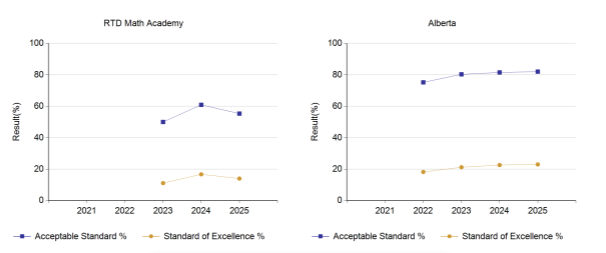
As a school serving grades 10-12 with a focus on mathematics education, diploma examination results are a primary measure of student achievement. RTD Academy students wrote diploma examinations in Mathematics 30-1, Mathematics 30-2, and Physics 30 during the 2024-25 school year.
Results Summary & Analysis
RTD Academy's 2024-25 diploma examination results fell below provincial averages, with an aggregated acceptable standard of 55.3% compared to the provincial average of 82.0%. Analysis of these results reveals a discrepancy between school-awarded grades and diploma examination performance, particularly in Mathematics 30-1 (44.3% gap) and Mathematics 30-2 (39.8% gap). This gap indicates that while students are engaging with course materials, the asynchronous assessment methods used previously may not have fully captured the depth of mastery required for standardized provincial examinations.
To rectify this and ensure our internal assessments accurately reflect student readiness, RTD Academy has implemented comprehensive measures for the 2025-26 school year. These include the introduction ofProctorio remote proctoring for all major assessments to ensure integrity, mandatory practice examinations under timed conditions, and enhanced diagnostic tools to identify learning gaps earlier in the course. These initiatives are designed to align school-awarded grades more closely with diploma outcomes and better prepare students for high-stakes testing environments.
Official Diploma Examination Report
Complete diploma examination data including course-specific results, year-over-year comparisons, and provincial benchmarks are available in our official APORI report.
View Official APORI Diploma Results Report (PDF)Analysis of Results
Context: Significant Growth During a Transitional Year
The 2024-25 school year represented a period of substantial growth and transition for RTD Academy. The number of students writing diploma examinations increased dramatically: Mathematics 30-1 grew from 68 to 169 writers (149% increase), and Mathematics 30-2 grew from 69 to 171 writers (148% increase).
Key Factors Contributing to Results
1. Assessment Integrity in an Asynchronous Environment
The most significant factor identified is a substantial discrepancy between school-awarded grades and diploma examination performance:
- Math 30-1 gap: 44.3 percentage points (97.6% school vs. 53.3% diploma)
- Math 30-2 gap: 39.8 percentage points (96.5% school vs. 56.7% diploma)
- Provincial averages: 19.1 and 21.9 percentage points respectively
2. Unique Challenges of Self-Directed Learning
Unlike traditional schools, our asynchronous model places significant responsibility on students for time management and self-regulation. Students may progress through content without developing the deep understanding required for diploma examination success.
3. Rapid Growth and Staffing Transitions
Significant changes in teaching staff, including new hires and role transitions, concurrent with substantial enrollment growth meant that some systems requiring adaptation at scale.
4. Insufficient Structured Diploma Preparation
Many students approached the diploma examination without sufficient practice under timed, exam-like conditions. The asynchronous model may have enabled some students to defer intensive exam preparation.
5. Course Repeat Dynamics
Students repeating courses to improve grades, having already written the diploma, showed reduced engagement with diploma preparation once achieving their target course grade.
Response Strategy and Improvement Initiatives
Proctorio Implementation
RTD Academy has implemented Proctorio remote proctoring technology across all courses:
- Identity verification to ensure registered students complete assessments
- Browser lockdown preventing access to unauthorized resources
- Activity monitoring with AI-assisted flagging of concerning patterns
- Customized security protocols for different assessment types
Enhanced Diploma Preparation Program
- Mandatory practice examinations under timed, proctored conditions
- Diagnostic assessments identifying specific content areas requiring focus
- Targeted intervention for at-risk students
- Study skills workshops for high-stakes mathematics examinations
Student Readiness Requirements
- Minimum competency on proctored practice examination before diploma registration
- Engagement expectations for students repeating courses
- Clear communication about course engagement and diploma success relationship
Targets for Improvement
| Measure | 2024-25 Result | 2025-26 Target | Long-Term Goal |
|---|---|---|---|
| Aggregated Diploma Acceptable | 55.3% | 65% | Match provincial avg |
| Aggregated Diploma Excellence | 14.0% | 18% | Match provincial avg |
| Math 30-1 School-Diploma Gap | 44.3 pp | 20 pp | Match provincial gap |
| Math 30-2 School-Diploma Gap | 39.8 pp | 20 pp | Match provincial gap |
RTD Academy acknowledges that meaningful improvement will require sustained effort and may take multiple years to fully realize. We are committed to transparent reporting on our progress.
3.2 Local Performance Measures
As a non-primary school, RTD Academy students complete Alberta Education's Assurance Survey through their primary schools of registration. To assess student experience and school effectiveness within our own context, RTD Academy conducts annual surveys aligned with provincial assurance domains.
Survey Results Summary
| Measure | 2023-24 Result | 2024-25 Result |
|---|---|---|
| Student Learning Engagement | 89% | 91% |
| Citizenship | 84% | 86% |
| Welcoming, Caring, Respectful & Safe Environments | 92% | 92% |
| Access to Supports and Services | 87% | 89% |
| Student Satisfaction | 89% | 91% |
| Parent Satisfaction | 90% | 90% |
Course Completion Rates
| Student Type | 2023-24 Rate | 2024-25 Rate |
|---|---|---|
| Home Education Students | 84.1% | 86% |
| Non-Primary Students | 78.2% | 81% |
| Summer School Students | 76.9% | 79% |
| Adult Students | 72.4% | 75% |
| Overall | 77.6% | 80% |
Home Education students continue to demonstrate the highest completion rates, reflecting strong family support structures. Adult students show the lowest completion rates, which aligns with unique challenges including work commitments and family responsibilities.
4. Teaching and Leading
4.1 Education Quality
As a non-primary distance education school, RTD Academy students complete Alberta Education's Assurance Survey through their primary schools of registration. Consequently, RTD Academy does not receive a provincial Education Quality measure from Alberta Education. To assess teaching effectiveness within our own context, RTD Academy conducts annual surveys and tracks local performance indicators aligned with provincial assurance domains.
Local Teaching Quality Measures
| Measure | 2023-24 | 2024-25 | Target |
|---|---|---|---|
| Student Satisfaction with Teaching | 89% | 91% | 92% |
| Parent Satisfaction with Teaching Quality | 90% | 90% | 91% |
| Feedback Quality (% helpful/very helpful) | 85% | 87% | 90% |
| Average Teacher Response Time | 6.2 hours | 5.8 hours | 5.0 hours |
Analysis of Teaching Quality Results
RTD Academy's local survey results demonstrate strong and improving satisfaction with teaching quality across both student and parent stakeholders. Student satisfaction increased from 89% to 91% year-over-year, reflecting the effectiveness of our asynchronous teaching model and the responsiveness of our Alberta-certified teachers. Parent satisfaction remained stable at 90%, indicating consistent quality in our communication and instructional delivery.
The improvement in feedback quality ratings from 85% to 87% suggests that our professional development focus on providing meaningful, actionable feedback in asynchronous environments is yielding positive results. Similarly, the reduction in average teacher response time from 6.2 to 5.8 hours demonstrates our commitment to accessible support despite the inherent challenges of online, self-paced learning.
While these results are encouraging, they must be interpreted in context with our diploma examination outcomes (Section 3.1). The gap between high satisfaction ratings and lower diploma performance indicates an opportunity to strengthen the alignment between day-to-day instruction and the rigorous demands of provincial assessments. Our assessment integrity initiative and enhanced diploma preparation program directly address this gap.
4.2 Professional Learning
RTD Academy operates in a rapidly evolving educational technology landscape where continuous professional learning takes a unique form. Rather than traditional training on external software platforms, our approach involves staff as active participants in the development and refinement of our proprietary systems. As a school that has built custom software—including our YourWay platform for student tracking, communication, and registration—our teachers are not merely learning to use tools; they are helping to shape them.
The pace of change at RTD Academy is fast, with new features added regularly based on operational needs and staff feedback. This collaborative approach means that professional learning is embedded in daily practice, with all staff contributing to identifying bugs, suggesting improvements, and guiding the direction of our systems. The result is a shared vision where everyone has ownership of the tools they use.
Professional Development Focus Areas 2024-25
YourWay Platform Development and Refinement
Our custom YourWay software serves as the central hub for student progress tracking, family communication, and registration management. Throughout 2024-25, staff participated actively in the platform's ongoing development—not as passive recipients of training, but as collaborators identifying workflow improvements, reporting issues, and testing new features. This participatory approach ensures that our technology genuinely serves teaching and learning needs rather than imposing external constraints.
Context-Aware AI Tutoring Systems
Teachers contributed to the development and implementation of AI-enhanced learning supports integrated into our course content. This work involved understanding how AI tutoring recognizes student learning patterns, provides personalized assistance, and flags students who may need additional human intervention. Teachers provided critical feedback on AI responses and helped refine the system's effectiveness for mathematics instruction.
Communication Platform Enhancements
Staff collaborated on improvements to our central messaging system and SendGrid-integrated communication tools. New capabilities including template sharing, batch communication, and interaction tracking were developed in response to teacher-identified needs, with staff involved in testing and refining these features before full deployment.
Data Analytics and Early Warning Systems
Our enhanced early warning system evolved through close collaboration between technical development and teaching staff. Teachers helped define which engagement metrics are most predictive of student success, and their insights shaped how the system presents information and recommends interventions.
Asynchronous Pedagogy
Ongoing professional learning in effective asynchronous teaching methodologies continued through peer collaboration and shared practice. Strategies for maintaining student engagement, providing meaningful written feedback, and creating effective self-paced content were developed collectively based on what staff observed working in their courses.
4.3 Managing Innovation and Change
RTD Academy's approach to innovation differs fundamentally from traditional change management models. Rather than top-down implementation of predetermined solutions, our culture embraces a collaborative development process where all staff contribute to shaping the direction of our school. This approach recognizes that the people doing the work daily have invaluable insights into what improvements are needed and how they should function.
The 2024-25 school year exemplified this collaborative culture as we refined our YourWay platform, expanded communication capabilities, and scaled operations to serve substantially more students. Throughout these changes, staff were not simply adapting to new systems—they were actively building them alongside our development team.
Collaborative Development Practices
Shared Ownership of Systems
When issues arise or improvements are needed, staff contribute directly to solutions rather than submitting requests and waiting for external fixes. Bug reports, feature suggestions, and workflow improvements come from across the team, and everyone understands that their input genuinely shapes the tools they use. This ownership creates investment in the success of our systems and reduces resistance to change.
Working Toward a Shared Vision
Our approach to innovation is guided by collective goals rather than imposed mandates. Staff discussions focus on what we want to achieve for students and how our systems can better support those outcomes. This shared vision means that changes feel purposeful and connected to our mission rather than arbitrary or disruptive.
Iterative Refinement
New features and processes are developed incrementally with continuous feedback from staff who use them. Rather than waiting for perfect solutions before implementation, we release improvements, gather real-world feedback, and refine accordingly. This iterative approach allows us to respond quickly to emerging needs while managing the pace of change.
Open Communication
Staff are encouraged to voice concerns, share observations, and propose alternatives. Regular communication channels ensure that everyone is aware of upcoming changes and has opportunity to contribute to planning. This transparency builds trust and ensures that diverse perspectives inform our decisions.
Cross-Functional Collaboration
The boundaries between "technical" and "teaching" roles are intentionally blurred. Teachers understand the capabilities and constraints of our systems, while development decisions are informed by educational priorities. This integration ensures that technology serves pedagogy rather than the reverse.
4.4 Leadership Development
RTD Academy recognizes that developing leadership capacity within our team is essential for sustainable growth and continuous improvement. As a school that has grown from startup to serving over 1,400 students, we are intentionally creating leadership opportunities and structures that distribute responsibility and develop professional capabilities across our staff.
Leadership Structure and Opportunities
Section Leadership
We are creating leadership roles within major sections of our school operations, including curriculum development, student support services, technology implementation, and assessment integrity. These roles provide teachers with opportunities to develop and demonstrate leadership competencies while contributing to organizational priorities.
Collaborative Decision-Making
Teachers are actively involved in decisions about curriculum development, technology adoption, and process improvements. This collaborative approach ensures that implementation strategies are informed by frontline teaching experience and builds ownership of organizational initiatives.
Mentorship
Experienced teachers mentor newer staff members in both the technical aspects of our unique platform and the pedagogical approaches effective in asynchronous mathematics instruction. This peer support accelerates onboarding and builds leadership skills in mentor teachers.
External Professional Learning
Staff are encouraged and supported to participate in external professional development opportunities, conferences, and professional networks that build capacity and bring new perspectives to our organization.
4.5 Teacher Supervision and Evaluation
RTD Academy's teacher supervision and evaluation processes align with the Teacher Quality Standard while addressing the unique context of asynchronous online instruction. Our approach emphasizes professional growth, ongoing feedback, and accountability for student outcomes.
Supervision Practices
Course Content Review
Regular review of course content, assessments, and student materials ensures alignment with curriculum standards and effective instructional design. This review process incorporates feedback from student performance data and stakeholder input.
Communication Quality Monitoring
Teacher communication with students and parents is monitored through our central messaging system to ensure timely, professional, and supportive interactions. Response time metrics and communication quality are reviewed as part of ongoing supervision.
Student Outcome Analysis
Teacher effectiveness is assessed through analysis of student completion rates, grades, and diploma examination results. This data informs professional growth goals and identifies areas where additional support or development may be beneficial.
Professional Growth Planning
Each teacher develops annual professional growth goals aligned with both personal development aspirations and organizational priorities. Progress toward these goals is reviewed regularly through supervisory conversations.
4.6 Expected Outcomes
Based on our Teaching and Leading strategies, RTD Academy has established the following targets:
- •Maintain student satisfaction with teaching quality at 90% or higher
- •Maintain parent satisfaction with teaching quality at 90% or higher
- •Improve feedback quality rating to 90% helpful/very helpful
- •Reduce average teacher response time to 5 hours or less
- •Continue collaborative development of YourWay platform with full staff participation
- •Establish formal leadership roles within each major operational section
- •Develop and implement comprehensive onboarding documentation for new teachers
These outcomes reflect our commitment to continuous improvement in teaching quality while acknowledging that the unique context of asynchronous online mathematics education requires collaborative professional development and leadership approaches where all staff contribute to building the systems and practices that serve our students.
5. Learning Supports
5.1 Welcoming, Caring, Respectful and Safe Learning Environments
As an asynchronous online school, RTD Academy's approach to creating welcoming, caring, respectful and safe learning environments differs from traditional brick-and-mortar schools but remains central to our educational mission.
Local Survey Results
| Measure | 2024-25 Result | Target |
|---|---|---|
| Welcoming, Caring, Respectful & Safe Environments | 93% | Maintain 92%+ |
| Students feel respected in the online environment | 92% | 93% |
| Students feel safe to ask questions | 91% | 92% |
Analysis of Results
RTD Academy's local survey results demonstrate consistently strong performance in creating positive learning environments, with 93% of respondents agreeing that our online environment is welcoming, caring, respectful and safe. This result significantly exceeds our internal target and reflects the supportive culture we have cultivated.
The asynchronous online environment presents unique considerations for student safety and wellbeing. Unlike traditional schools where physical safety is a primary concern, our focus centers on digital safety, respectful online communication, and creating an environment where students feel comfortable seeking help without fear of judgment. Our high scores in this domain suggest that students and families appreciate the supportive, non-judgmental atmosphere we have cultivated.
Several factors contribute to these positive results. Our communication protocols emphasize respectful, encouraging interactions in all teacher-student communications. The asynchronous model itself removes some sources of anxiety present in traditional classrooms, such as fear of answering incorrectly in front of peers or social pressures that can accompany in-person learning. Students can engage with challenging material privately, ask questions without peer observation, and learn at a pace that suits their individual needs.
Digital Safety Measures
RTD Academy maintains comprehensive digital safety protocols including:
- Secure learning management system access with individual student credentials
- Clear acceptable use policies communicated during registration
- Privacy protections for student information and communications
- All teacher-student communications occur through monitored school platforms
5.2 Access to Supports and Services
Local Survey Results
| Measure | 2024-25 Result | Target |
|---|---|---|
| Access to Supports and Services | 89% | 90% |
| Satisfaction with teacher response time | 88% | 90% |
| Awareness of available support resources | 85% | 88% |
Analysis of Results
Survey results indicate that 89% of students and parents agree that students have access to appropriate supports and services. While this represents positive performance approaching our 90% target, the results also highlight an ongoing opportunity to better communicate available supports and ensure students utilize them effectively.
The satisfaction with teacher response time (88%) reflects our efforts to enhance responsiveness in the asynchronous environment. Average teacher response time decreased from 6.2 hours to 5.8 hours during the 2024-25 school year, with our target being 5 hours or less. Given the asynchronous nature of our courses, response time is a critical metric for student support—students cannot simply raise their hand and ask a question, so timely email and messaging responses are essential.
The awareness of available support resources (85%) suggests that our enhanced orientation processes and communication about available supports are having a positive impact, though further improvement is needed. Analysis indicates that students who engage with our orientation materials and utilize available supports demonstrate higher completion rates and academic performance.
Support Services Available
RTD Academy provides a range of support services tailored to the asynchronous online learning environment:
Academic Support
Direct teacher access via email and messaging, detailed feedback on assignments, video explanations for common problem areas, practice resources and additional examples, and flexible scheduling for virtual office hours when needed.
Technical Support
Platform orientation resources, technical troubleshooting assistance, Proctorio setup support, and equipment requirements guidance.
Progress Monitoring
Weekly automated progress reports, early warning system identification, proactive teacher outreach for struggling students, and detailed gradebook access for students and parents.
5.3 Enhanced Progress Tracking and Communication Systems
RTD Academy is making significant investments in technology systems to better track student progress automatically and provide timely notifications to students and families. These improvements represent a major enhancement to our learning supports infrastructure.
Automated Progress Tracking
We are developing enhanced systems to automatically track student progress across multiple dimensions. These systems will monitor assignment completion rates, assessment performance trends, login patterns and engagement metrics, time spent on course materials, and progression through course content relative to scheduled timelines. By automating this tracking, we can identify students who may be struggling earlier and more consistently than manual monitoring allows.
Automated Notification Systems
A key improvement initiative is the development of automated notification systems that proactively communicate with students and parents. These systems will provide:
- Automatic alerts when students fall behind their scheduled pace
- Regular progress summaries sent directly to parents
- Milestone notifications when students complete course sections
- Early warning notifications when engagement patterns indicate potential concern
- Reminders for upcoming deadlines and assessment dates
- Celebration messages when students achieve learning milestones
These automated communications will supplement, not replace, personal teacher outreach. The goal is to ensure that no student falls through the cracks due to delayed identification of concerns, while freeing teacher time for more meaningful one-on-one support interactions.
Comprehensive Parent Portal
RTD Academy is creating a comprehensive parent portal system that will provide parents with full access to their child's progress in real time. This represents a significant enhancement to our family engagement capabilities. The parent portal will include:
- Real-time gradebook access: Parents will be able to view current grades, assignment scores, and assessment results as soon as they are recorded
- Progress visualization: Clear visual representations of student progress through course content, including pace relative to scheduled completion
- Engagement metrics: Information about login frequency, time spent on coursework, and participation in learning activities
- Communication history: Access to teacher communications and feedback provided to the student
- Schedule integration: Connection with the student's learning schedule showing upcoming deadlines and milestones
- Direct messaging: Ability to communicate directly with teachers through the portal
This parent portal addresses feedback we have received about families wanting more visibility into their child's learning journey. In an asynchronous environment where parents cannot observe their child attending classes, real-time access to progress information is essential for family involvement in education.
5.4 Context-Aware AI Learning Support
RTD Academy is actively developing and implementing context-aware artificial intelligence systems integrated directly into our course content. This initiative represents a significant investment in learning supports for asynchronous students.
Development Status
The AI learning support system is designed to provide personalized, immediate assistance to students working through course content. Unlike generic AI tutoring tools, our system is context-aware, meaning it understands where students are in the curriculum, what concepts they have previously encountered, and common misconceptions or difficulties associated with specific content areas.
Key features under development include:
- Immediate response to student questions (available 24/7)
- Socratic method-based guidance leading toward understanding
- Recognition of student struggle patterns with automatic teacher notification
- Personalized practice problem generation
- Integration with early warning system
Alignment with Assessment Integrity
The AI support system is being developed in conjunction with our Proctorio assessment integrity initiative. While the AI provides substantial help during learning, assessments remain secure and proctored. This approach ensures that students receive maximum support during the learning process while assessment results accurately reflect their independent mastery—directly addressing the school-diploma gap identified in Section 3.1.
6. First Nations, Métis and Inuit Student Success
6.1 FNMI Student Demographics
RTD Academy served 28 course enrollments from self-identified First Nations, Métis, and Inuit students during the 2024-25 school year. As an online asynchronous school specializing in mathematics and STEM education, we provide flexible learning opportunities that can accommodate cultural and community commitments while ensuring access to quality mathematics instruction regardless of geographic location.
The 2024-25 school year represented RTD Academy's first year with FNMI students participating in diploma examinations. Five FNMI students wrote the Mathematics 30-1 diploma examination and five wrote the Mathematics 30-2 diploma examination. Due to small cohort sizes (fewer than 6 students per measure), individual course results are suppressed in provincial reporting to protect student privacy.
6.2 FNMI Student Achievement Results
Diploma Examination Results
| Measure | RTD Academy (FNMI) | Alberta (FNMI) | Achievement Rating |
|---|---|---|---|
| Diploma Acceptable Standard | 50.0% | 77.5% | Very Low |
| Diploma Excellence Standard | 10.0% | 11.9% | Low |
Note: Course-specific results are suppressed due to small n-sizes. The above represents aggregated diploma results across both mathematics courses.
These results indicate that FNMI student achievement on diploma examinations is an area requiring significant attention and improvement. RTD Academy is committed to understanding the factors contributing to this gap and implementing targeted strategies to better support FNMI student success.
Course Completion Results
| Measure | FNMI Students | All Students | Gap |
|---|---|---|---|
| Course Completion Rate | 42.9% | 77.6% | -34.7% |
| Courses Completed | 12 of 28 | — | — |
| Unenrolled/Withdrawn | 16 of 28 | — | — |
The completion rate gap between FNMI students and the overall student population represents the most significant equity challenge identified in our 2024-25 results. Analysis of this data reveals that FNMI students are withdrawing from courses at substantially higher rates than other student groups, indicating a need for enhanced early identification and culturally responsive support systems.
6.3 FNMI Grant Funding
RTD Academy did not receive FNMI-specific grant funding for the 2024-25 school year. As a non-primary school, FNMI grant allocations flow to students' primary schools of registration rather than to RTD Academy. Despite not receiving dedicated FNMI funding, RTD Academy remains committed to supporting FNMI student success through our core programming and targeted strategies outlined below.
6.4 Strategies and Activities
RTD Academy implemented the following strategies to support FNMI student success during 2024-25:
Flexible Learning Model
Our asynchronous delivery model provides scheduling flexibility that can accommodate cultural and community commitments, including ceremonies, family responsibilities, and seasonal activities that may conflict with traditional school schedules. Students can engage with course content at times that work for their circumstances while still receiving support from Alberta-certified mathematics teachers.
Personalized Support Framework
Teachers provide individualized support through regular check-ins, progress monitoring, and responsive communication. Our early warning system identifies students who may be falling behind, triggering outreach and intervention. However, as our completion data indicates, these supports were not sufficiently effective for our FNMI student population in 2024-25.
Accessible STEM Education
RTD Academy's online model removes geographic barriers to specialized mathematics instruction. Students in rural, remote, and Indigenous communities can access the same quality mathematics and STEM courses as students in urban centres, addressing equity gaps in course availability.
6.5 Assessment of Impact and Areas for Improvement
Honest Assessment
The strategies implemented in 2024-25 did not achieve the desired outcomes for FNMI students. The 42.9% completion rate and "Very Low" diploma achievement rating demonstrate that our current approaches are insufficient to meet the needs of FNMI learners. While our flexible model theoretically supports diverse student circumstances, the data indicates we have not translated this flexibility into successful outcomes for FNMI students.
Contributing Factors Under Investigation
RTD Academy is examining several factors that may contribute to these outcomes, including the effectiveness of our early intervention timing, the cultural responsiveness of our course content and communication approaches, and whether our support systems adequately recognize and respond to the unique contexts of FNMI students.
Growth Indicator
Early 2025-26 enrollment data shows 65 FNMI students already registered with RTD Academy, representing substantial growth from the previous year. This increased interest demonstrates that Indigenous students and families see value in our flexible online model. This growth intensifies our responsibility to improve outcomes and ensure these students are well-supported.
6.6 Priorities for FNMI Student Success (2025-26)
Based on our results analysis, RTD Academy has identified the following priorities for improving FNMI student outcomes:
Enhanced Early Identification
Strengthen our early warning system to identify FNMI students at risk of withdrawal within the first two weeks of enrollment, enabling earlier intervention and support.
Culturally Responsive Communication
Review and revise our communication approaches to ensure they are welcoming and responsive to diverse cultural contexts. This includes examining the frequency, tone, and methods of outreach to FNMI students and families.
Community Partnership Development
Pursue relationships with Indigenous communities and organizations to better understand the specific needs and contexts of FNMI learners and to develop collaborative approaches to student support.
Completion-Focused Interventions
Develop targeted intervention strategies specifically designed to support FNMI students in completing their courses, addressing the identified 34.7 percentage point completion gap.
Data Monitoring
Implement more frequent monitoring of FNMI student progress throughout the year, enabling responsive adjustments to support strategies rather than year-end analysis alone.
RTD Academy acknowledges that meaningful improvement in FNMI student outcomes will require sustained effort, genuine engagement with Indigenous perspectives, and willingness to adapt our practices based on evidence of what works. We are committed to this work and to transparent reporting on our progress.
6.7 English Language Learners (ELL) Student Achievement
Demographics and Data Limitations
As a non-primary school, RTD Academy does not independently assess or designate English Language Learner status. ELL designations are maintained by students' primary schools of registration and transferred to RTD Academy through PASI. RTD Academy acknowledges that our current systems for tracking and reporting ELL student data require improvement. Strengthening our data collection processes for ELL identification is a priority for the 2025-26 school year to enable more comprehensive analysis and targeted support.
Diploma Examination Results
| Measure | RTD Academy (ELL) | Alberta (ELL) | Achievement |
|---|---|---|---|
| Diploma: Acceptable Standard | 36.4% | 67.4% | Very Low |
| Diploma: Standard of Excellence | 12.1% | 14.8% | Low |
Note: Previous year results suppressed (*) due to fewer than 6 students.
Analysis
ELL student performance on diploma examinations is an area requiring significant attention. Contributing factors likely include the same assessment integrity and diploma preparation challenges affecting all students, potentially compounded by additional barriers in a text-heavy asynchronous learning environment where students work independently without immediate access to clarification or language support.
Supports and Priorities
RTD Academy's asynchronous model allows ELL students to engage with content at their own pace, revisiting material and utilizing translation tools as needed. Our context-aware AI tutoring system, currently in development, will include features designed to support students who may benefit from additional explanation or alternative approaches to complex mathematical language and terminology.
Priorities for 2025-26 include:
- Data Collection: Improve systems for identifying and tracking ELL students to enable more comprehensive analysis and targeted intervention.
- Integrated Support: Ensure ELL student needs are addressed within our overall diploma improvement strategy, with attention to language-specific barriers in mathematics instruction.
- AI-Enhanced Assistance: Develop AI tutoring features that can recognize when students may benefit from simplified explanations or alternative representations of mathematical concepts.
7. Governance
7.1 Parental Involvement
As a non-primary distance education school, RTD Academy students complete Alberta Education's Assurance Survey through their primary schools of registration. Consequently, RTD Academy does not receive a provincial Parental Involvement measure from Alberta Education. To assess parental engagement within our own context, RTD Academy conducts annual surveys and tracks local performance indicators.
Local Parental Engagement Results
| Measure | 2023-24 | 2024-25 |
|---|---|---|
| Parent Satisfaction with Communication | 90% | 90% |
| Parents Feel Informed About Progress | 88% | 86% |
| Parent Survey Response Rate | 68 responses | 110 responses |
Board Advisory Structure
RTD Academy has historically faced challenges in establishing a formal parent advisory council. As an online asynchronous school serving students from across Alberta, our parent community is geographically dispersed, and many families engage with RTD Academy as a supplementary educational provider rather than their child's primary school.
2025-26 Initiative: RTD Academy is committed to establishing a Parent Advisory Council in the 2025-26 school year. This council will include representation from both our distance education families and our home education (RTD Connect) families.
Current Parent Communication Methods
- Weekly Progress Emails: Teachers send detailed weekly progress updates to all parents
- Central Messaging System: Direct, tracked communication between school staff and families
- Parent Portal: Currently in development to provide real-time access to progress and grades
- Direct Teacher Access: Parents can communicate directly with teachers via email and messaging
7.2 Financial Summary
RTD Academy is funded primarily through the non-primary distance education grant and operates without tuition fees for Alberta students. Our financial management prioritizes direct investment in student learning while maintaining operational sustainability. The complete audited financial statements are available in Section 10: Web Links.
Independent Auditor's Report
Opinion: "In our opinion, the accompanying financial statements present fairly, in all material respects, the financial position of the Group as at August 31, 2025, and the results of its operations and cash flows for the year then ended in accordance with Canadian accounting standards for not-for-profit organizations (ASNPO)."
Audited by Vista Accounting Professional Corporation, December 10, 2025.
Key Financial Highlights
Financial Turnaround
RTD Academy achieved a significant financial turnaround in 2024-25, moving from a deficit position to positive net assets. This improvement reflects strong enrollment growth and disciplined financial management as we scaled our operations to serve more students.
Revenue Growth
Total revenue nearly doubled year-over-year, driven primarily by increased enrollment in our distance education programs. The majority of our funding comes from Alberta Education grants, ensuring accessibility for all Alberta students without tuition fees.
Investment in Student Learning
The largest portion of our expenditures (approximately 74%) is directed toward salaries and wages for teachers and support staff, reflecting our commitment to direct student support. Sub-contracted services, which include specialized educational technology development, represent the second-largest expense category.
Strong Cash Position
Operating activities generated positive cash flow, strengthening our financial foundation for continued growth. This improved liquidity positions RTD Academy to invest in key initiatives outlined in our Education Plan, including AI-enhanced learning support and assessment integrity systems.
Board Leadership
| Board Member | Role |
|---|---|
| Nikki Allen | Board Chair |
| Danielle Wilson | Treasurer |
| Candace Perras | Director |
| Sherry Haarstad | Director |
| Toni-Lee Hazlett | Director |
7.3 Resource Management
RTD Academy's budget is carefully aligned with our educational priorities to ensure optimal resource allocation for student success. Our budget supports key initiatives across all five assurance domains, with resources directed toward achieving the outcomes identified in our Education Plan.
Critical Priority Initiatives
Two initiatives have been identified as critical priorities requiring significant resource allocation:
1. Proctorio Implementation
Full deployment of remote proctoring across all courses to enhance assessment integrity and reduce the gap between school-awarded grades and diploma examination results. This initiative directly addresses the concerning school-diploma gaps identified in our Student Growth and Achievement analysis.
2. Context-Aware AI Learning Support
Major technology investment for personalized learning support across all mathematics courses. This AI-enhanced system provides immediate, 24/7 assistance to students, adapts to individual learning patterns, and integrates with our early warning system to identify students requiring additional human intervention.
Strategic Budget Priorities Aligned with Education Plan Goals
Student Achievement
Resources allocated to "Rock the Diploma" preparation program, enhanced support for Math 10C and Math 20-2 (courses with lower completion rates), data analysis tools and performance tracking systems, and personalized learning pathway development.
Teaching & Leading
Investment in professional development for asynchronous teaching methodologies, multimedia learning materials development, teacher collaboration platforms, and instructional innovation initiatives.
Learning Supports
Development of machine learning early warning system, AI-powered student support systems, peer mentoring program infrastructure, and adult student retention initiatives.
Governance & Communication
Parent portal development, communication platform enhancements, dashboard and analytics tools for stakeholder reporting, and stakeholder feedback systems.
STEM Access & Equity
Development of applied mathematics and computer science courses, rural and remote school partnerships, targeted outreach programs, and FNMI student support framework.
Technology Infrastructure
Remote proctoring systems (Proctorio), AI platform deployment and maintenance, analytics and reporting platforms, and security and privacy enhancements.
Financial Controls
- Implementation of Xero accounting system for transparent financial tracking
- Enhanced transaction documentation and categorization
- Regular financial reconciliation and monthly board reporting
- Multi-level approval processes for significant expenditures
- Annual independent audit by qualified external auditors
- Quarterly budget review by the Board of Directors to ensure alignment with educational priorities
7.5 Stakeholder Communication
As an online asynchronous school, RTD Academy faces unique challenges in maintaining effective communication with stakeholders. Our analysis of stakeholder feedback and engagement patterns reveals both strengths in our current approach and opportunities for further enhancement.
Current Communication Analysis
- Weekly Email Updates: High open rates among primary and parent recipients, with room for improvement among non-primary students
- Parent Communication: Currently relying primarily on email communication as our parent portal is still in development
- Primary School Collaboration: Varying levels of engagement with the schools of our non-primary students
- Student Feedback Response Rate: Varies significantly across different student categories
- Board Reporting: Regular, structured reporting with opportunities for more data-driven insights
Communication Enhancement Strategies
- Custom Communication Software Enhancement: Further develop our proprietary communication platform to enable more granular targeting of messages based on student type, course enrollment, academic status, and engagement level.
- Dashboard Innovation: Redesign stakeholder dashboards to provide more intuitive, visual representations of student progress and engagement, with parent dashboards focusing on individual student progress and board dashboards highlighting school-wide trends.
- Systematic Feedback Collection: Implement more systematic approach to collecting stakeholder feedback through strategic pulse surveys, focus groups, and automated feedback collection integrated into key interactions.
- Enhanced Orientation Process: Develop more comprehensive orientation program for all stakeholders that clearly outlines communication channels, expectations, and resources.
7.6 Expected Outcomes
Based on our governance strategies and alignment with our Education Plan, RTD Academy has established the following expected outcomes:
- Successfully develop and implement a robust parent portal to enhance parent engagement
- Establish Parent Advisory Council with representation from both distance education and home education families by January 2026
- Improve stakeholder satisfaction with communication clarity and relevance
- Enhance response rates to stakeholder surveys across all student categories
- Increase the percentage of parents who report feeling "well-informed" about their student's progress
- Establish more effective communication channels with partner schools for non-primary students
- Establish data-driven decision making at all levels of governance
- Create more transparent reporting on strategic goal achievement to all stakeholders
- Complete timely financial audit and reporting for 2025-26
8. Local and Societal Context
8.1 Unique Context and Mission
RTD Academy serves a diverse student population across Alberta, with our asynchronous model providing accessibility to high-quality mathematics and STEM education regardless of geographic location, personal circumstances, or traditional educational barriers. This section examines our school's unique context within Alberta's educational landscape and our role in expanding access to quality STEM education.
Bridging the Rural-Urban Gap
A significant portion of our non-primary student base resides in rural or remote communities where specialized courses like Mathematics 31 (Calculus) or Physics 30 may not be offered due to low enrollment numbers or staffing challenges. RTD Academy ensures that a student's postal code does not determine their access to advanced STEM education.
Supporting Diverse Life Circumstances
Our asynchronous model is essential for students who cannot attend traditional schooling due to elite athletic commitments, medical challenges, employment requirements, or family responsibilities. By decoupling learning from a rigid bell schedule, we allow these students to pursue academic excellence without compromising their other life commitments.
8.2 Response to Societal Needs
Addressing the STEM Skills Shortage
Alberta's economy is increasingly diversifying into technology and engineering sectors. By providing accessible, high-standard mathematics and physics education, RTD Academy directly contributes to the province's talent pipeline, preparing students for post-secondary programs in engineering, computer science, and the sciences.
Lifelong Learning and Adult Education
With over 17% of our student body comprised of adult learners, RTD Academy serves a critical societal function in workforce development. We enable adults to upgrade their qualifications for career advancement or post-secondary admission in a manner that respects their employment and family obligations.
9. Summary and Future Priorities
9.1 2024-25 Highlights
- Significant enrollment growth serving 1,735 unique students across Alberta
- Successful implementation of Proctorio secure assessment protocols
- Maintained high satisfaction rates: 90% Parent Satisfaction and 91% Student Learning Engagement
- Expansion of STEM programming with Physics 20 and Physics 30
9.2 Areas for Continued Improvement
- Reduce the discrepancy between school-awarded grades and diploma examination results
- Formalize the Parent Advisory Council to enhance stakeholder engagement
- Improve completion rates for adult learners and non-primary students
- Enhance data collection and support strategies for FNMI and ELL students
9.3 Priorities for 2025-26 Education Plan
Assessment Integrity
Full deployment of remote proctoring and timed practice exams to align internal grades with provincial standards.
Student Success Systems
Implementation of Context-Aware AI Learning Support and automated Early Warning Systems.
Governance
Establishment of a formal Parent Advisory Council by January 2026 to ensure diverse stakeholder representation.
Inclusive Education
Targeted strategies for FNMI and ELL student achievement, including culturally responsive communication.
10. Web Links
Documents
| Document | Link |
|---|---|
| AERR Permanent Link | rtdacademy.com/aerr/2024-25 |
| Education Plan 2025-26 | View Education Plan |
| 2024-25 Budget | View 2024-25 Budget |
| Audited Financial Statements | View Audited Financial Statements |
11. Annual Report of Disclosures
Public Interest Disclosure (Whistleblower Protection) Act
Pursuant to Section 32 of the Public Interest Disclosure (Whistleblower Protection) Act, RTD Academy is required to report annually on any disclosures of wrongdoing that were received under the Act during the reporting year.
RTD Academy received no disclosures of wrongdoing during the 2024-25 school year.